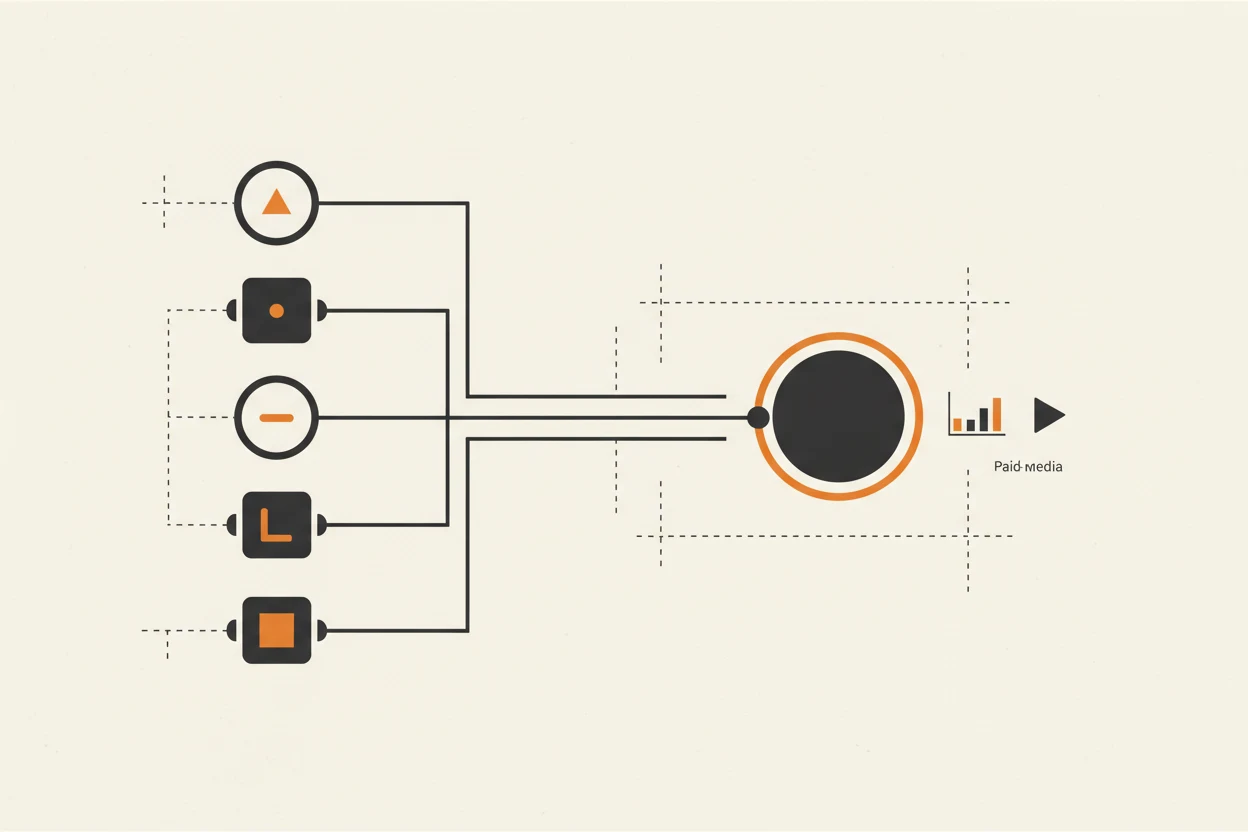
For about a year now I’ve been quietly rebuilding the boring parts of my workflow around a stack I call OpenClaw. It’s not a single product — it’s a set of small, purpose-built bots wired to the surfaces I actually live in: Meta Ads Manager, GA4, Looker Studio, my CRM, and a Notion board for client comms. Each bot does one thing well. Together they’ve handed me back somewhere around 10–12 hours a week.
This post is the architecture, not the prompt library — the prompts evolve constantly. What’s stable is the shape.
Why a bot stack, not a chat window
Most marketers I know use ChatGPT or Claude in the chat window. Open a tab, paste a question, copy the answer back. That’s fine for one-off tasks. It’s not fine if you’re doing the same task 40 times a week across multiple clients.
The OpenClaw setup flips that. Each bot:
- Lives at a specific entry point in my workflow (a shortcut, a button in Notion, a scheduled run)
- Has a frozen prompt that I’ve iterated on for weeks
- Knows how to talk to specific APIs (Meta Marketing API, GA4 reporting, Looker Studio)
- Returns output in a format I can act on without manual cleanup
If I want to ship 20 ad copy variants for a new account, that’s one bot. If I want a Friday client summary across three campaigns, that’s a different bot. They don’t share state, they don’t try to be general-purpose, and they don’t waste tokens being conversational.
The five bots I run today
1. Brief → Variants Input: 1-paragraph brief + audience snapshot + brand tone notes. Output: 25 ad copy variants split across hooks, bodies, and CTAs, with each variant tagged by angle (urgency, price, social proof, transformation). I’ll cover this one in detail in a separate post.
2. Audience Researcher Input: ICP description + market. Output: a structured list of Meta interests, LinkedIn job titles and seniorities, and intent signals I can plug into audience builders. It also flags overlap risks and suggests exclusion audiences.
3. Weekly Summary Runs Friday morning. Pulls last-7-days metrics from GA4 + Meta Ads API, compares against the previous 7 and 28 days, and produces a client-ready narrative. Drafts go into a Notion review queue so I can scan and ship — never the other way around.
4. Anomaly Detector Runs daily at 9am. Pulls campaign-level metrics for every active account, flags anything more than 2 standard deviations from the 14-day mean. The output is a 3-line “what changed and where to look” message in Slack. It saves me from finding bad news on Monday morning.
5. Pitch Helper For new business. Input: a discovery call transcript + the prospect’s website. Output: a draft proposal structure, a rough monthly budget recommendation based on their industry and goals, and 5 angle ideas for the first campaign. I always rewrite the proposal, but the bot kills the blank page.
What I deliberately don’t let it touch
This part matters as much as what it does:
- No bid changes. OpenClaw can suggest, but only I push.
- No publishing. Drafts go to a queue. A human (me) ships.
- No client communication. Drafts only. I rewrite for tone, every time.
- No PII handling. Anything client-side that touches PII goes through hashed inputs only.
- No silent retries. If something fails, it pages me, not silently fills the void with hallucinated data.
The discipline isn’t paranoia — it’s that the moment a bot ships something I can’t defend, the whole stack loses my trust. And a stack I don’t trust is a stack I don’t use.
How the savings actually compound
The hours saved isn’t the headline number — what compounds is decision speed. When the Friday report writes itself, I’m thinking about creative on Monday instead of typing. When anomalies surface at 9am instead of 9pm, I catch broken accounts before they burn budget. When 25 ad variants take 12 minutes instead of three afternoons, I can run twice as many creative tests.
The accounts I run on this stack scale faster. Not because the AI is smarter than me — it isn’t — but because I get to spend my brain on the parts of the work where being smart actually matters.
I’ll walk through the Brief → Variants bot prompt-by-prompt in the next post. And the Weekly Summary + Looker integration in the one after that. If you’re rebuilding your own workflow, those two are the biggest unlocks — start there.